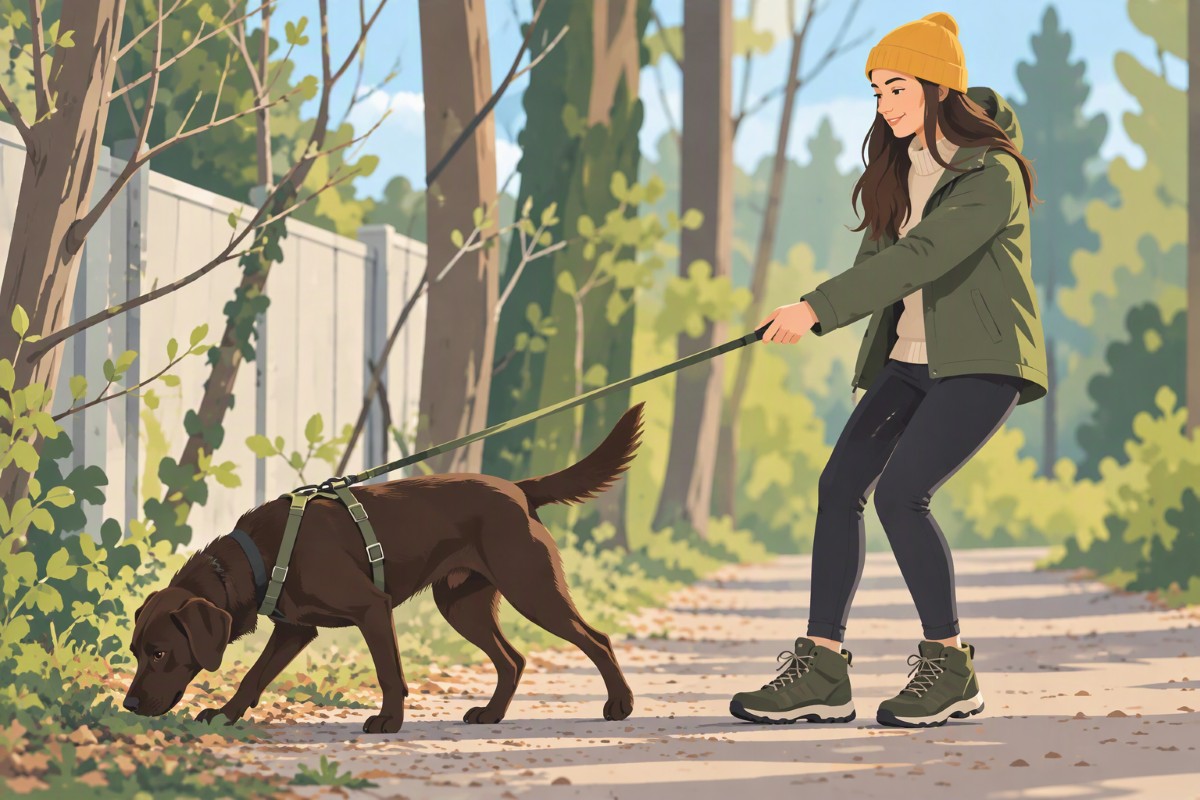
Who is the walk for? You or your dog?
Next time you take your dog for a walk, ask yourself one simple question: Who gets to decide what makes this a good walk?
The answer may not be the same for you and your dog.
Many of us get dogs because we want a more active life. We want to get outdoors. Walk. Run. Cycle. Climb mountains. Ski. Explore forests and trails.
And here in Norway, people are particularly good at this. We love being outdoors, and our dogs often get to join us on our adventures.
But then there are the everyday walks. Around the neighbourhood. Along the road. On the pavement. Around the same lake or through the same park. The familiar route we have walked hundreds of times before.
How often do we stop and ask: What is this walk actually like for my dog?
A walk is more than getting from A to B I often see dogs who are barely given the opportunity to investigate the world they are moving through.
The dog stops to sniff a patch of grass. The leash tightens and the dog is pulled along.
The dog turns towards an interesting scent. A tug on the leash. The dog stops at a lamppost. “Come on.” Because we're supposed to be WALKING. For us
a walk often means moving from A to B. We think about distance, pace, exercise or completing our usual route. We count our steps, track our kilometres and record the walk in our fitness apps. We chase results.
For your dog, however, the most interesting part of the entire walk might be contained within the 20 centimetres of grass you have just pulled your dog away from.
To a dog, smells contain information. Who has been here? How long ago? Was it a familiar dog? A stranger? What has happened here since yesterday? The world your dog experiences through scent is extraordinarily rich, and sniffing gives your dog an opportunity to investigate that world.
Yet old ideas about control still influence the way we walk our dogs. The dog should not decide where we go. The dog should not stop whenever they want to. The dog should follow us. And somehow, giving a dog too much freedom is still sometimes presented as a risk, as though allowing a dog to make choices means losing control?
I recently came across advice from a dog trainer that essentially said: “Control the nose, and you control the dog.”
The idea was that the dog should only be allowed to stop and sniff when given permission. Sniffing should happen in one designated place during the walk, ideally the same place each time, in order to create a predictable habit. And I couldn't help thinking:
Where's the fun in that?
Imagine someone invites you sightseeing in a city you have never visited before. Every time you stop to look at something interesting, you are pulled along. "No, don't stop there. Don't look at that. We're not going into that shop. Don't take a photograph. We're going left. Keep up. We need to keep moving." At one designated point on the tour, you are finally allowed to look around, take a couple of photographs and experience your surroundings. Then it is time to move again. Would you consider that an interesting sightseeing trip? Probably not. And yet, sometimes this is remarkably similar to the experience we create for our dogs.
Maybe distance isn't the most important thing? Perhaps we need to think a little less about how far we walk and a little more about what our dogs experience while we are out. Let your dog stop. Let your dog finish sniffing. Sometimes, let your dog choose which direction to go. Give your dog time to investigate something interesting.
Let your dog spend an unreasonable amount of time sniffing that particular bush, even when it is raining and you cannot possibly understand what is so fascinating about it. Be patient. Sniffing, exploring and having opportunities to make choices can help create a walk in which your dog has more control and autonomy.
A one-kilometre walk where your dog gets to investigate, sniff, make choices and use their senses may sometimes be far more valuable to your dog than five kilometres walked at marching pace.
Some walks can simply belong to your dog Of course, not every walk has to be this way. Sometimes we have to go somewhere. We're heading into the mountains or the forest. We are exercising, hiking or have a destination to reach. Those walks can be our walks.
But perhaps some walks can simply be the dog's walk. Not an obedience exercise. Not transportation from A to B. Not another workout that needs to be recorded in an app.
Just half an hour where your dog is allowed to experience the world in their own way. To stop. To sniff. To investigate. To choose. And perhaps, every now and then, to decide what makes a walk a good walk.