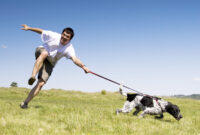
How to get your dog to stop pulling on the leash
So why is your dog pulling on the leash?
There could be a wide range of reasons to why your dog is pulling on the lead.
- Old habit
- Stress, pain, fearaggression, learned behaviour, disease
- A poorly ajusted harness or other equipment - your dog might be trying to get away from the discomfort of the equipment.
- Your dog doesn't like you, or is worried or afraid of you
- predatory behaviour or maybe females in heath nearby?
- Are you using a flexi lead?Your dog might be desensitised to the pulling as there's always tension on the lead.
There's always a reason, dogs just don't do things without a motivation behind it. The problem is - how do we find the reason, and what can we do to solve it?

How do you get your dog to stop pulling?
It may save you time and effort to take your dog to a dog behaviourist - we can assess and observe and help you find the reason as to why your dog is behaving the way they are. If stress and/or pain is the underlying reason, we need to look at our dog's entire life situation, not just the pulling behaviour. There are often issues that needs to be resolved prior to your dog being comfortable enough to really work on the pulling issue. When your dog is stress free, pain free and able to concentrate and learn, you can follow the steps below to practice your loose leash walking with your dog.
Start the training indoors in calm surroundings without much distractions. Train the attention sound that you'll later use outside on the walk. The goal with the attention sounds for the dog to give you their attention, not necessarily by looking (contact training) at you, but being attentive to you and ready to follow you when you turn, or follow other directions. You use operant onditioning to link the behaviour with a reward. the dog has to voluntarily offer you the behaviour of giving attention(ears listening, maybe stopping or pausing, moving in your direction - and then he gets the reward (treat praise etc). When you're nailing it indoors, you can move to a quiet spot outdoors until your dog nails it there as well, and then increase the difficulty by adding more distractions like dogs, people, birds, traffic. Eventually the dog will always be aware of you, and be attentive to your directions to the extent that all you need to do is change directions, and he'll follow. No attention sound, no yanking the lead, no cues needed other than you walking in a different direction. Doesn't that sound like a relaxing and calm walk?
Do you still find it hard to make loose leash walking work?
There are countless reasons for why you don't succeed with loose leash walking with your dog. It's always a good idea to talk to a professional trainer that know how to help you and your dog be successful. We're happy to help.
. Here's a list over a few of the most common mistakes a lot of people do (you're not alone): is being unclear when you train so that your dog does not understand what you want. Not being consistent is another one. Or that you change direction so often that the dog learns that if they just wait a little bit you will come back the other way again - because you only go a few steps the other way. If you train too often or too rarely it can also affect the result, or if you train when the dog is busy with something else or hungry. If your dog has high stress levels or underlying illnesses it can be difficult for you to teach your dog new things.
Walking on a loose leash is NOT the same as heeling!
Loose leash walking is not contact training where your dog needs to look you in the eyes. In the dog world a direct stare is considered to be rude and threathening. It's enough for our dog to either look in your direction, or too show with body language that they are paying attention to you. If you've previously trained your dog to stare at you and heel, untrain it now by not staring back, and look away until your dog gets fed up and does something else. For a dog it's uncomfortable and even painful to tilt his head to constantly look up at you. Just imagine how you feel after talking to someone on a plane, or in a meeting, where the people you talk to are seated next to you. Your neck hurts from tunring to the side. Still, many of us ask this from our dogs on walks. It may lead to other issues in your dog, like muscle tension, skewed weigh carrying, lameness, causing pain and discomfort for your dog - and stacking up Vet bills down the line!
Be Patient.

Sometimes it's one step forward and two steps back. Notice and celebrate your wins:-) Follow the recipe and do it correctly and your dog will be loose leash walking like a dream within a month or even weeks. This is off course, depending on no underlying issues that needs to be addressed first. if you suspect something else is going on
If you suspect something else is going on, please reach out to us, and we'll help you and your dog get moving in the right direction.
 EN
EN  NB
NB